DEVLENS SPECIAL · Analysis · Funding Intelligence · 30 October 2026
Foreign grants to NGOs are at a seven-year high. Global aid has had its worst year on record. Both are true, and the gap between them is where Bangladesh’s smaller NGOs are disappearing.
Foreign grants released to non-governmental organisations (NGOs) in Bangladesh reached US$838.25 million in fiscal year 2025-26 (July to June), the highest in seven years, according to the NGO Affairs Bureau (NGOAB).
Donors also pledged a record $1.15 billion for new NGO work that year, up 44.62% and the largest annual commitment since the bureau began keeping records, the Financial Express reported in July.
Those numbers arrived in the same year that aid from wealthy countries fell 23.1% in real terms, the steepest drop ever recorded by the Organisation for Economic Co-operation and Development (OECD). And on 6 October, the Bangladesh Institute of Development Studies (BIDS) warned that about 2,200 small and medium-sized NGOs are at risk of running out of money.
Devlens reviewed six years of NGOAB figures, the BIDS study, OECD and UK government data, Rohingya response funding records and reporting from Dhaka’s main newspapers. The evidence points one way: the money has not disappeared from Bangladesh, but it is reaching fewer, larger organisations.
Key findings
- Totals have recovered, on paper. Releases to NGOs rose 28% in two years, from an eight-year low of $655 million in FY24 to $838 million in FY26. But a weaker dollar and 8.7% inflation mean FY26’s real spending power was no higher than FY25’s.
- Much of it is old money. BIDS says funds for projects approved in earlier years are still flowing, while new project approvals have fallen to 1,654 from 2,061 in FY22.
- Small NGOs are shrinking fast. Budgets of NGOs that rely only on grants fell by an average of 40%, against 12% for those with microfinance income.
- Big players are moving down-market. Large organisations now bid for small grants that once sustained local NGOs, sector professionals told The Business Standard.
- Local groups hold almost none of the Rohingya money. UN agencies hold 87.96% of 2026 Joint Response Plan funding; national NGOs hold 4.26% and local NGOs none, according to COAST Foundation.
From an eight-year low to record pledges
DEVLENS SPECIAL · DATA
Releases recovered after an eight-year low
Foreign grants released to NGOs, US$ million, with new pledges, by fiscal year (July to June)
FY20
945
FY21
779
FY22
821 · pledged 1,031
FY23
741 · pledged 720
FY24
655 · pledged 841
FY25
795 · pledged 794
FY26
838 · pledged 1,150
Source: NGO Affairs Bureau data reported by the Financial Express (2022 to 2026). Pledges for FY20 and FY21 not published in the reports used. Covers grants approved through the bureau; excludes UN agencies’ own spending. Graphic: Devlens Bangladesh.
Two years ago the trend pointed down. Releases fell 11.6% to $655 million in FY24, the third annual fall in a row and the lowest in eight years, The Business Standard reported. Sector leaders blamed donor attention shifting to Ukraine, Gaza and Africa, and Bangladesh’s expected graduation from Least Developed Country (LDC) status.
After the July 2024 political transition, many NGO leaders reported fresh donor interest. The data show it turned into money. Releases rose almost 21% to $794.86 million in FY25, then 5.46% to $838.25 million in FY26.
The peak remains FY19, when NGOs received $955.35 million. FY26 is still 12% below that level.
Why the totals rose after USAID left
The recovery happened through the biggest aid shock the sector has faced. A US stop-work order in January 2025 halted USAID-funded activity in Bangladesh, apart from emergency food aid including support for Rohingya refugees. USAID ceased to exist as an agency on 1 July 2025.
Four factors explain why the NGOAB totals still went up, and one of them is not new money at all.
Other donors stepped in for emergencies. In FY25, development partners increased support for flood-hit and climate-affected areas, and some sent more money through local partners, according to insiders quoted by the Financial Express.
The pipeline is still emptying. BIDS said Tk 101.43 billion was released in FY26 for previously approved projects, and that Bangladesh has not yet felt the full effect of global cuts.
Pledges are not cash. Commitments rose 17% in FY24 while releases fell 12%. An NGOAB official told the Financial Express in 2024 that commitments often do not reflect the real trend, because donors change plans or approvals stall.
A weaker dollar flatters the total. The bureau reports releases in US dollars, and the dollar had its worst year since 2017 in 2025. The euro rose about 14% against it during the year, and sterling hit a record high against the taka in June 2025. Grants set in euros or pounds by European and UK donors therefore converted into more dollars. FY26 releases rose 5.46% in dollar terms while the euro averaged roughly 8 to 10% higher than in FY25, so much of the increase may be currency conversion rather than new money. The bureau does not publish releases by donor currency, so the effect cannot be measured exactly.
In local terms the gain disappears. The taka stayed between Tk 120 and Tk 123 to the dollar across both years, so FY26 releases rose roughly 7% in taka. Inflation averaged 8.68% over the year, which means NGOs’ real spending power was flat or slightly lower than in FY25. The FY25 rise, by contrast, was real even after inflation.
The global squeeze is only starting
DEVLENS SPECIAL · INFOGRAPHIC
The aid squeeze in six numbers
Why record NGO totals in Bangladesh hide a shrinking sector
GLOBAL
-23.1%
Fall in global aid in 2025, the largest on record
Source: OECD, April 2026
UNITED STATES
55 of 59
USAID projects in Bangladesh shut after the January 2025 stop-work order
Source: AUDP via The Daily Star
UNITED KINGDOM
£66.7m to £31m
UK bilateral aid to Bangladesh, 2025-26 to 2026-27
Source: FCDO figures via Dhaka Tribune
JOBS
20,000 to 50,000
Estimated development jobs lost. No official count exists
Source: Caritas, AUDP, sector estimates
ROHINGYA RESPONSE
37%
Funding gap in the 2026 Joint Response Plan, already cut 26%
Source: JRP update via TBS, May 2026
LOCAL NGOs
2,200
Small and medium NGOs at risk as new project approvals fall to 1,654
Source: BIDS, October 2026
Job-loss figures are estimates from sector groups, not official data. Graphic: Devlens Bangladesh, 30 October 2026.
The OECD’s preliminary data, published in April, show official development assistance fell to $174.3 billion in 2025. The five largest donors accounted for 95.7% of the fall, and US aid alone dropped 56.9%. The OECD expects a further 5.8% decline in 2026.
The United Kingdom, long one of Bangladesh’s largest bilateral donors, is cutting its aid to 0.3% of national income. UK bilateral aid to Bangladesh will fall from £66.7 million in 2025-26 to £31 million in 2026-27, according to figures reported by the Dhaka Tribune. A UK-funded Practical Action climate project in the Sundarbans was told in April to close in June, two years early.
This matters because FY26’s record pledges were made before most of these cuts reach country programmes. Whether they turn into cash in FY27 is the sector’s biggest open question.
One pressure has eased for now. In June the UN Committee for Development Policy recommended moving Bangladesh’s graduation from Least Developed Country status from November 2026 to November 2029, which keeps trade preferences and near-zero-interest loans in place for longer. UN General Assembly endorsement was still pending as of July, according to the Atlantic Council.
Who is not getting the money
DEVLENS SPECIAL · DATA
The money is not reaching local hands
Share of 2026 Rohingya Joint Response Plan funding held, by type of appealing partner
UN agencies
87.96%
International NGOs
7.78%
National NGOs
4.26%
Local NGOs
0% (not an appealing partner)
Source: COAST Foundation and Cox’s Bazar CSO-NGO Forum analysis, August 2026 (not independently verified).
Average NGO budget decline, by funding model
Grants only
-40%
With microfinance
-12%
Source: Bangladesh Institute of Development Studies (BIDS), survey of 46 NGOs, presented 6 October 2026. Graphic: Devlens Bangladesh.
The BIDS findings, presented by research director Kazi Iqbal, draw on organisation-level data from the NGOAB and the Microcredit Regulatory Authority, plus a survey of 46 NGOs. The 2,200 organisations most at risk have no microfinance arm and depend almost entirely on grants.
The number of new projects is falling. NGOAB approved 1,836 projects in FY25, according to the Financial Express, and BIDS put the FY26 figure at 1,654. Record pledges spread across fewer projects mean larger average awards, which favour organisations with the systems to manage them. NGOAB has not published the project-level data that would confirm how FY26 money was split by organisation size.
Reporting on the ground points the same way. In May, development professionals told The Business Standard that organisations which once ignored projects under $2 million now compete for $100,000 grants. Several international contractors, including Chemonics International and Tetra Tech, closed their Bangladesh offices. Surviving NGOs are replacing permanent staff with consultants paid per deliverable.
Localisation, the donor commitment to fund local organisations directly, has helped some. But the national NGOs best placed to win direct grants are the larger ones. BRAC’s executive director, Asif Saleh, told the paper that only a small fraction of climate finance reaches locally led work.
The Rohingya response shows the pattern
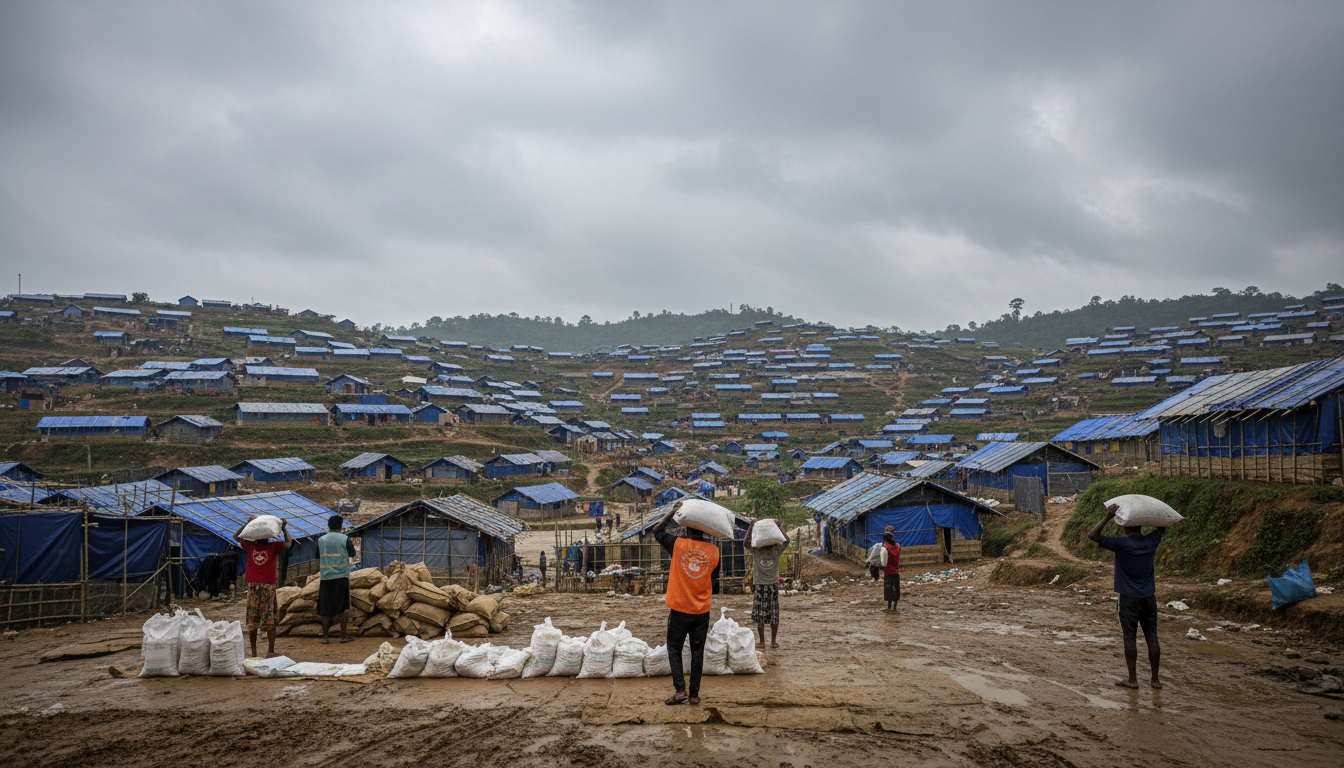
The clearest public data on who holds the money come from Cox’s Bazar. The 2026 Joint Response Plan (JRP) seeks $710.5 million for 1.56 million refugees and host community members, 26% less than in 2025. As of early April, $436.9 million had been received or committed, leaving a 37% gap, The Business Standard reported.
An analysis by COAST Foundation, presented with the Cox’s Bazar CSO-NGO Forum in August, found UN agencies held 87.96% of JRP funding, international NGOs 7.78% and national NGOs 4.26%. Local NGOs held none as appealing partners. Of about $150 million in recent US funding, 92% went to UN agencies and 8% to international NGOs, the groups said.
COAST campaigns for a greater role for local organisations. Devlens has not independently verified its figures.
The human cost: no official count
No government body has counted the jobs lost. Estimates vary widely:
| Estimate | Source | Date |
|---|---|---|
| Over 50,000 jobs, 55 of 59 USAID projects shut, $700m in aid lost | Association of Unemployed Development Professionals (AUDP) | May 2025 |
| Over 20,000 jobs, 100+ projects worth $550m suspended | Caritas; repeated by The Business Standard | 2025 to 2026 |
| 30,000 to 40,000 jobs | Sector estimates reported by The Daily Star | March 2025 |
| Over 1,000 termination letters at icddr,b | The Business Standard | January 2025 |
The gap between 20,000 and 50,000 is too wide to support any single figure. Devlens reports the range and calls on the NGOAB and the Ministry of Labour to publish an official assessment.
Why it matters
Headline totals suggest a sector in recovery, and policymakers may read them that way. Organisation-level data say otherwise for the 2,200 small and medium NGOs that work closest to communities. If funding keeps concentrating in fewer, larger projects and UN-led responses, the localisation commitments donors have made since 2016 will be harder to meet.
Finance Minister Amir Khosru Mahmud Chowdhury told the BIDS seminar that NGOs should cut their dependence on foreign grants and take a bigger part in government programmes. The study recommends:
- a public list of NGOs eligible for government procurement and corporate social responsibility (CSR) funds
- guidelines to put the NGO provisions of procurement rules into practice
- dedicated funds for smaller NGOs through the NGO Foundation and Palli Karma-Sahayak Foundation (PKSF)
- provisions for implementing organisations in the draft CSR policy
- legal recognition and tax benefits for social businesses
What to watch
- Whether FY26’s record pledges become FY27 releases, or repeat FY24’s pattern of pledges outrunning cash.
- NGOAB sector and organisation-level data for FY25 and FY26.
- The UN General Assembly’s decision on Bangladesh’s LDC deferral.
- Government action on the BIDS proposals, including procurement guidelines and the draft CSR policy.
- Direct JRP funding for local NGOs in Cox’s Bazar.
About this analysis
This Devlens Special is built on official and institutional data: NGO Affairs Bureau records of foreign grants released to and committed for NGOs from FY2019-20 to FY2025-26; the Bangladesh Institute of Development Studies study of NGO financing presented on 6 October 2026; OECD Development Assistance Committee aid statistics for 2025; UK Foreign, Commonwealth and Development Office allocations; and 2026 Joint Response Plan funding data. Devlens compiled the bureau’s figures into a single six-year series and calculated every change and share shown in this report. The series covers foreign grants approved through the NGO Affairs Bureau and does not include UN agencies’ own spending. All graphics are by Devlens Bangladesh.
Images: illustrations generated with Google Gemini. They are not photographs. Graphics: Devlens Bangladesh.
Sources
- NGOs’ foreign grant receipts hit 7-year high of $838.25m in FY’26, Financial Express, 18 July 2026
- Foreign aid pledges for NGOs slip amid surge in disbursements, Financial Express, 16 July 2025
- Release of NGOs’ funds showing a waning trend, Financial Express, 26 October 2024
- Foreign funds to NGOs hit eight-year low in FY24, The Business Standard
- Uptick in funds for NGOs in BD, Financial Express, 9 August 2022
- 2,200 NGOs at risk of funding crunch, shows BIDS study, bdnews24.com, 6 October 2026
- International aid fell sharply in 2025, says OECD, OECD, 9 April 2026
- Sundarbans climate project to close early amid UK aid cuts, Dhaka Tribune, 24 August 2026
- How Bangladesh’s local NGOs are surviving the foreign aid collapse, The Business Standard, 11 May 2026
- Bangladesh lost $700m in aid as USAID halted most projects, The Daily Star, 28 May 2025
- USAID fund cut: Job losses shock development workers, The Daily Star, March 2025
- USAID cuts hit Bangladesh hard, DevelopmentAid, citing Caritas
- Bangladesh seeks $710m as Rohingya plan faces 37% funding gap, The Business Standard, 2026
- UN agencies hold 88pc of Rohingya response funds, Financial Express, August 2026
- Nepal and Bangladesh are delaying LDC graduation. Now comes the hard part., Nischal Dhungel, Atlantic Council, 31 July 2026
Spotted an error? Tell us and we will correct it. Read our editorial standards.